Showing posts with label Middle Ages. Show all posts

Friday, May 17, 2013

Kalamazoo 2013 - Marginalia


There are several advantages in attending Kazoo, which you might view as a kind of Comicon for medievalists. First and foremost you are placed in the immediate proximity of a couple thousand often very smart people who frequently have similar or related interests to your own. A professional conviviality arises that is unobtainable elsewhere, since at home you are likely regarded as an eccentric or a social deviant, and there are probably not enough medievalists resident at your institution to even form a committee. 

An ongoing concern with medieval studies is the relentless quest for sources, and here you have a chance to examine the presenters to see if they’re on to something you’ve overlooked or haven’t yet discovered. I do this constantly, and sometimes it really pays off. The luminaries in the profession often show up here, the people you’re always quoting in your footnotes. It’s fun to see and hear them, and even talk to them as much as the objective circumstances permit. 

Of the 250 sessionsit's the biggest academic conference in the U.S. about two dozen are scheduled simultaneously, meaning that no matter how much you hustle, you will never attend more than ten per cent. You spend most of your free time trying to make up your mind from the catalog which sessions to visit. Nonetheless there inevitably comes the moment when you’ve exhausted your own interests, so you show up at a session concerning something about which you know absolutely nothing. And it’s exactly these encounters that open new doors, point to new directions. 

In contrast with much of academia, the study of the Middle Ages is not so much hard-wired as it is endlessly diffuse. Almost everything that humans get interested in, almost every sphere of human activity you can imagine—from numismatics and bee-keeping to interstellar travel has some kind of medieval correspondence, in some cases also its point of origin. And that’s the advantage of Kalamazoo, where one really gets close to this vast ocean of strangeness and alterity. It's like a distant planet situated both behind and before us, one which recedes from view the closer we get to it, as we marvel at its blurry, colorful enormity. It is truly a wonderment. 

                                                                 *    *    *

FAVORITE PAPER TITLES

 “Runes and Gold Bracteates: The Futhark Sequences as Mythic Mnemonic.”

“Doing It Doggy Style on Medieval Seals” 

“A Typology of Pre-Tailored Men’s Garments Based on Key Measurements and Proportions, or, How Tall Was Saint Louis and Who Wore His Shirt?” 


COMPLAINTS 

The almost non-existent shuttle bus service between the buildings completely sucks, compared with previous years when the bus ran every ten or fifteen minutes. 

The soft ice-cream machine in the cafeteria was down on Day Two. This must never happen again. 

There should be introduced a bus service that goes to the Kazoo train station at 1pm on Sunday to meet the Wolverine back to Chicago. 


Kalamazoo 2013 - 4/4

DAY THREE

Up betimes to prepare my presentation entitled “The Gargoyles of Yerba Buena: Medievalist Architectural Innovation in San Francisco 1900-1940” at the morning session. Unfortunately it coincided with the one event I really wanted to attend this year: a roundtable entitled “The Future We Want,” presided by Jeffrey Jerome Cohen, whom I’ve corresponded with but not yet met.

The purpose of my own paper was to show what was distinctive about the profusion of medieval buildings that went up in San Francisco after the fire in 1906, and to argue more generally that medievalist architecture of the 20th century—because of the innovation of cast concrete as a construction technology and the new kinds of buildings in which it was employed—e.g. office buildings, high schools, Laguna Honda Hospital, SF Art Institute, etc.—deserves to be studied separately from either its Gothic Revival (1840-1860) or its Victorian Gothic (1870-1890) predecessors. In other words, medievalism in the 20th century had different things to offer than in the 19th.

Trinity Episcopal Church at Bush and Gough is the best example of castellated church architecture in San Francisco. Surely the ghost of Hamlet's father would feel at home on these lonely battlements, which may have been erected for defense against raids by the Unitarian-Universalists, who are located in a likewise medievalist church building just two blocks away.

The fact that one had to present this in a twenty-minute time slot, the norm for most academic conferences I’ve attended, is completely ridiculous. Still I thought it important to make my complete argument, which seemed to go over pretty good, and I was asked interesting questions. I am grateful to SF State Univ for sending me to spread word of the glory of medieval San Francisco.

Trying to provide an interesting presentation in twenty minutes is like trying to fly with one’s wings clipped, and it has the annoying effect of causing speakers to rattle off their learned discourse at breakneck speed, for fear of exceeding the time limit. This makes it often hard to understand what they’re talking about. I think there ought to be two thirty-minute presenters, followed by a brief pause to allow the disenchanted to escape, and then thirty minutes of discussion for enthusiasts.

In the afternoon I attended two BABEL sessions about “Plunder” and “Blunder” organized by Eileen Joy. We began with a talk about the motion and the vectors (travel paths) of “things,” such as the relics of  San Marco during the Venetian Republic, and then we looked at hordes of “things” that that possess auras and signify lost utopias, ranging from the dragon’s hoard at the end of Beowulf to the objects collected in a Masonic Temple museum somewhere in Massachusetts that houses—quite uselessly, since nobody ever comes to visit—a host of “things” that functioned as symbolic ritual objects during the golden age of male fraternal organizations in America.

A dozen or more short presentations followed on a variety of topics that concerned other things besides “things,” and the afternoon concluded with a lengthy and animated audience discussion about what to do about the process of peer review in journal submissions, which in its present condition seems to upset everyone (myself included, don’t get me started).

Eileen Joy made the altogether sensible, if unlikely suggestion that we should aim to construct publishing as a means of conducting a free and open conversation amongst ourselves wherever we are located as humanities students, and that the criticism from or among reviewers and editors should follow this goal.

But one could argue I think that a male-oriented, adversarial sensibility is at the historical core of the academic process, just as it operates in the Anglo-Saxon judicial trial system and in parliamentary party politics. Just think of the tradition of university debates and medieval disputation—going back to Peter Abelard, who wandered the streets of Paris like a lone samurai questing for philosophical combat.

In general I thought the BABEL workgroup folk obviously enjoy projecting their self-image of something resembling a Parisian street mob during the French Revolution, intent upon demolishing academic hierarchies and traditional shibboleths* such as certain traditional vectors of peer review in the publication process.

But being a Sixties radical myself, their position, if the Babelites collectively may be said to have one, seems far too conservative. After all, when I first went to grad school in America, there weren’t even any women present, and because of the existing institutional censorship there were all sorts of things you couldn’t even begin to talk about in class—including for example why there weren’t any women or minorities present.

My hat is off to the Babelites anyway. Incidentally, if you're involved with Critical Theory in medieval studies, these are the people to hang out with. It seems pretty much absent elsewhere at Kalamazoo.


*Hebrew shibbōleth: literally, freshet, a word used by the Gileadites as a test to detect the fleeing Ephraimites, who could not pronounce the sound sh  (Judges 12:4–6).


Kalamazoo 2013 - 3/4


DAY TWO

This was probably the most productive day for me, due to a small epiphany I experienced at a talk given by Jonathan Couser concerning emotionality (or evidently more often the lack of it) in the letters of St Boniface. He spoke of Barbara Rosenwein’s concept of “emotional communities,” and asked if one might be able to contemplate a “history of the emotions” for the Middle Ages. Patrick Geary mentioned separate rhetorics involved with modes of emotional expression—for a rough example: one might choose a different vocabulary when one talks with teachers or priests. I had an interesting conversation with Jonathan at lunchtime the next day to refine the matter a bit.

I had written and also presented (at a Medieval Association of the Pacific conference in Santa Clara last year) about the “poems of male friendship” and the homoerotic imagery richly, indeed outrageously present in the letters of Carolingian churchmen. It occurred to me that I could revisit this whole topic conceptually in terms of an existing emotional community, which from my perspective is doubtless the most blatantly emotional within the entire E.M.A.

In the afternoon on to Fred Astren’s paper on the activities of rabbis in the medieval Mediterranean, followed by a whole bunch of other interesting stuff. 


Thursday, May 16, 2013

Kalamazoo 2013 - 2/4


DAY ONE

A morning session featured a discussion of relations between the French and the papacy in the 11th century, and a presentation about Bonifatius (St Boniface, an Anglo-Saxon who converted many Germans, and founded monasteries and helped organize the German church in the early 8th c.). This scholar seemed knowledgeable about every single contemporary clerical comment written down about the indigenous heathens, worshipers of Odin/Wotan.

I asked if one could identify some kind of turning point following the Reform Movement after the Concordat of 1122 when the popes, having deposed the German emperors from leadership of the church, decided to mix it up with French. There clearly are plenty of good reasons why the popes would want to, but what exactly triggered their interventions in French affairs?

Then I asked what the condition and organization of the German church was at the time of Boniface and if anyone had found out when the first German monastery was founded, following Clovis’ conversion  ca. 500. (They used not to call them the Dark Ages for nothing.) As I  anticipated, the answer in both cases was no, but this is the kind of question one can profitably ask at Kalamazoo, just to confirm one’s own perceptions while ignoring the taint of public humiliation over one’s putative ignorance.

In the afternoon I heard Richard Matthew Pollard, Univ British Columbia: “Identifying the Men behind the Popes in Early Medieval Rome: An Exercise in Methodology,” which I found really brilliant. I can’t recapitulate the argument here, but the idea is roughly that through analysis of Latin prose rhythms we can determine (for example) which letters Pope Gregory I. wrote himself, and which he assigned to his chancery, and this is turn may inform us about which matters he held most important.

Having come to medieval studies only six years ago after a long career teaching English and German, I have lacked any real opportunity for manuscript studies, and I am full of envy for Richard’s experience and expertise. I spoke with him afterwards, and I was surprised that he remembered me from our brief conversation at Kazoo in 2009, when he was still a doctoral student at Cambridge with Rosamond McKitterick, the great genetrix of modern Carolingian studies. Richard totally made my day when he mentioned that he had used my Walafrid Strabo translations in a class he taught.

An evening session devoted to Walter Gofford’s one-hour contemplation of Charlemagne’s conscription policies conducted me also into the physical presence of early medieval military historians Bernie Bachrach and Kelly DeVries, hitherto known to me only from the printed page.
 
Dr Gofford impressed me as more than a little snarky, which I suppose at his advanced age is understandable. He spent a full five minutes castigating Timothy Reuter for writing that Charlemagne’s armies were conscripted from “magnates and their followings,” when (if I understood correctly) Reuter might have more accurately written “magnates and allodial landowners,” so as to include the participation of the liberi (freemen).


Wednesday, May 15, 2013

Kalamazoo 2013 - 1/4

48TH INTERNATIONAL CONGRESS ON MEDIEVAL STUDIES AT KALAMAZOO MICHIGAN
MAY 9-12, 2013
                                                                                              

GETTING THERE

The flight to O’Hare proceeded without incident, and I had the satisfaction of riding the marvelously anachronistic Chicago Elevated Railway for 50 minutes into the city in order to transfer at Union Station (ticket =$5). Unhappily both the elevator and escalator at Clinton were out of service, compelling me to schlepp my impedimenta four flights of stairs skywards, an unwelcome challenge since I banged up my knee a couple  years ago in the SFSU parking lot and have been hobbling around with a cane ever since.

I collapsed into my seat on the Amtrak Wolverine and prepared for the two-hour journey to Kalamazoo. Compared with the California Coast Starlight, it was a remarkably fast and smooth ride, comparable almost to the better European trains. We passed through the industrial ruin that Gary, Indiana, has become—Hephaestus’ forge is apparently extinguished in these precincts forever—and, after a few tantalizing glimpses of Lake Michigan in the distant twilight, we pressed on to my complete surprise past one of the most adorable Richardsonian Romanesque railroad stations I have ever laid eyes on, in the town of Niles, MI.

Niles Michigan Station. Photo: Poul Thor Hansen. Clicking embiggens.

In a mad moment I was severely tempted to pull the emergency brake and run out to photograph it, but according to a loudspeaker announcement we had achieved our maximum speed of 110 mph—beat that California Coast Starlight!—and I feared that at this dazzling tempo the train would never be able to come to a stop before we had come half-way to Kalamazoo.

On the bus from the train station to the Western Michigan University campus I fell into conversation with a young archaeologist from Ireland named Fiona who had come a long way to present about a dig she was undertaking somewhere in an Irish county whose name was unfamiliar to me. It happened also that Fiona was not only cheerfully conversant but also drop-dead gorgeous. Crazed from the stress of travel and falling victim to a sudden attack of courtly love, I felt like throwing myself to her feet and saying: “Take me, Fiona, I am yours forever, do me with me as you will, I will serve and obey you in all things and never desert you, etc., now explain to me every little detail about your marvelous Celtic excavations.”

Figuring that given my current age group—ridiculously, I have now become 73— not much might arise from my abruptly conceived infatuation, I wearily trudged off to my assigned accommodation. This year I decided to play the disability card with my house assignment and was given what must be considered an executive suite compared to the jail cells they stash the unfortunate undergrads and the other conference visitors in at this place. The cafeteria is just downstairs, and I don’t have to share the bath with anyone, all for the same thirty clams per day they charge everyone.


Thursday, July 7, 2011

Calixtinus has gone missing


Arose this morning to receive the dreadful intelligence that the 12th-c. manuscript Codex Calixtinus has been stolen from the cathedral at Santiago de Compostela in northern Spain. This ms. is valuable for a whole lot of reasons, including the remarkable  folios that contain some of the earliest transcriptions of polyphonic music. I wonder what in the world the thieves are expecting to do with it, and I hope that the cathedral staff has had it professionally digitized, in which case it should be made available online so we can all enjoy it.

Beneath the picture of Charlemagne's army, who look suspiciously like Crusaders, we see the great man Hisself and some friends tippy-toeing off to Santiago on a red carpet. The architectural drawing suggests that architects had gotten away from Roman-style red-tile roofing by the 11th century.


Photo WikiCommons Fitxategi:Codex Calixtinus (Liber Sancti Jacobi) F162v siglo XII.

+

Saturday, June 11, 2011

Anal fire

Württembergische Landesbibliothek Stuttgart, Codex bibl. fol 23: folio 94v


I had been puzzling for some weeks over this picture in the Stuttgart Psalter (Paris, 820-830 CE) which illustrates Psalm 77, Verse 66:

Et percussit inimicos suos in posteriora: obprobrium sempiternum dedit illos. (Vulgata)

And he smote his enemies in the hinder parts: he put them to a perpetual reproach. ((KJV) 

Were these butt-rockets dispensed by the Lord for sodomitical transgressions committed by the victims? What other anal improprieties could have incurred the Lord's displeasure?

The answer came to me immediately from the opening pages of Jeffrey Cohen's Medieval Identity Machines, which reference King Alfred the Great's problems with hemorrhoids. These hellish afflictions may have been more common in the Early Middle Ages than we have supposed. Or perhaps the artist, similarly afflicted and lacking Preparation H, postulated an act of divine retribution.

In modern times, piles of course were the subject of a very popular Johnny Cash song entitled "Ring of Fire."

+


Friday, May 27, 2011

More cowbell!

.
Gallensis Cod. sang. 21

Thanks to the good offices of Prof Maureen Miller in the UC Berkeley History Dept, who was kind enough to accept me to her graduate seminar "The Long Tenth Century" for next semester, I shuffled around in some obscure corners of e-codices last weekend and came up with this marvelous picture taken from a St Gall psalter dating from around 900.

You'll have to click on it to see it in detail, but there are some real surprises here. Just for starters, the guy at the upper left who looks like Richard Wagner is playing a rebec which has f-holes carved into it, and he does so with a long bow while holding it under the chin like a modern fiddler.

That may not appear especially earthshaking, but consider how often you've heard a rebec player in a medieval consort using a short bow and holding the instrument in her lap for reasons of alleged authenticity.

King David's instrument on the other hand seems altogether phantastical, except that I do remember seeing something similar elsewhere. Could that be a Swiss cowbell attached to it? In words familiar to a certain generation of Saturday Night Live viewers: MORE COWBELL!

What's clear however is that instrument builders at the beginning of the tenth century are experimenting with hour-glass-shaped instruments fitted to the player's knee, which will eventually morph into guitars.

The king's exotic headgear signifies perhaps that he is Jewish. The artist may be getting his Jews mixed up with his Byzantines, but that almost-conical hat looks somewhat like those worn by the ashkenazim (Rhineland Jews) in the 12th-13th c. (as amply depicted in Schreckenberg: The Jews in Christian Art.)

However, Erich Toch says in New Cambridge Medieval History there is no record of Jewish settlements in Francia before the mid-tenth c., so how in the world would this 9th c.German artist know about such things? (Rabbi Benjamin of Tuleda’s later census shows that there were precious few communities around the Mediterranean littoral, where Jew mainly co-existed harmoniously with Muslims as trading partners.)

Fancy headdress for prelates and monarchs in the medieval tradition are of course still worn, nowhere with more aplomb than by HH the Dalai Lama.


+

Tuesday, May 17, 2011

Was King David a guitar god?

I’ve been much occupied lately with a marvelous ninth-century manuscript called the Stuttgart Psalter, which originated in the scriptorium of the abbey of St Germain des Prés around 820-830, the same time as its more famous counterpart, the Utrecht Psalter. It’s called the Sturttgart Psalter because that’s where it wound up, and the entire ms. has been beautifully digitized by the Württemberg Landesbibliothek in Stuttgart.


Württemberg Landesbibliothek Stuttgart, Cod. bibl. fol. 23: folio 163v

The psalter shows King David playing not the typically-seen lyre—an Anglo-Saxon lyre in the English-Irish psalters and a Greco-Roman one in others—but rather he is shown playing a chordophone instrument referred to as a cithara in the Latin psalm text, from which the word guitar (gitarra in Spanish) is ultimately derived.


This instrument appears a half-dozen times in the Psalter, shown perhaps most clearly at folio 055r where it is played with a plectrum, and it appears also theorbo-sized folio 108r, suggesting that it may have been used at service because it is played in front of an altar with the gospels open on it.


In the picture we see King David and his Germanically-costumed hot combo, which includes a woman playing Moroccan clackers in the upper right, a naked dancing boy, and some guys trying to figure out how to make the bellows work the pipe-organ in the lower right, plus a cat upper left blowing a horn that looks suspiciously like a cornetto, since it's bent in shape.


I think it would be fun to reconstruct these instruments and play them together, noting that the basic requirements for a modern R&B group are satisfied: percussion, keyboard, sax, plus of course  lead guitar and vocals. (Only a bass is missing, for which we have to wait till the invention of Renaissance consort instruments.) It is nonetheless clear that there may have been more going on in Paris in the 820's than we suspected!


Considering that the invention of the guitar evidently goes back to the late Bronze age as explained here, it is conceivable that King David— if he existed to begin with—might have played one in the 10th c. BCE.


The hour-glass shaped instrument is fretted, which suggests that the Hittites may have used musical scales.

+


Monday, April 25, 2011

Bostonia and Jeffrey J. Cohen

I was pleased with the exchange of comments I had with Jeffrey Cohen on In the Middle this weekend, in which we briefly marinated in nostalgia about the defection of Brigham's ice cream from Harvard Square. I don't know why I wax Proustian about Boston at this time of year, but after all April is the cruelest month, comme on dit, I suppose because of the start of a new Red Sox season.
Prof Cohen (George Washington University) is in my view the most innovative medievalist of the past decade.

+

Saturday, September 25, 2010

Copyright protection in the Middle Ages

Speaking of composing curses, Got Medieval has drawn our attention to the doubtless justified medieval habit of prefacing books with written curses targeting thieves. The effect may have been similar to the FBI warnings which nowadays introduce rented DVD’s, as for example:

Saturday, September 18, 2010

Greenpersons

OMG I think I've stumbled across what may be the world's first illustration of a green man, actually in this case a green woman. I found it in the Stuttgart Psalter, object of my research for this semester which dates from 820-830 AD at the monastery of St. Germain des Pres.


The Psalmist (135:6-10) speaks of "Him that stretched out the earth above the waters... that made great lights... the sun to rule by day... the moon and stars to rule by night." In this charming picture we see Terra holding wheat and leafy plants in her hands while disgorging grapevines from her mouth. Above her left and right are sun and moon, with a couple stars in the center..

All those modern druid and wiccan types who proudly point to the green man trope as a pre-Christian, Celtic pagan symbol, should note that in this case, the green woman is presented in a Biblical context. Given the priorities of this period it does not seem likely that the Church would be anxious to incorporate pagan iconography into its liturgical repertory -- these psalters were probably used for monastic service or for private devotions. So it's possible that the trope is descended rather from Late Antiquity.

In related matters, I was Googling around for greenman images and came up with this charming photo of a greenman tree person, executed evidently with only a chainsaw:


Paul Sivell carved lots more which are presented at http://thecarvedtree.com/Greenmen.htm. How nice it would be if this kind of stuff could be done in Golden Gate Park, although I do imagine eucalyptus wood is much too soft.

Saturday, June 19, 2010

Saturday Gallimaufry -- Medieval edition

1. A medieval castle is under construction in Arkansas, of all places.

2. But it will probably not have as fine a tower as Westgate in Canterbury, now to be saved from closure.

3. It’s been confirmed that the remains found in a lead casket in Magdeburg Cathedral last year does indeed contain what’s left of Queen Editha, an Anglo-Saxon princess who became the first wife of Otto the Great. Her body was reinterred in 1510 into a lead coffin, and her skeleton was wrapped in silk cloth dating from the 10th century.


Otto and Editha in happier days, a sculpture in Magdeburg Cathedral from the 13th century. Sic transit gloria mundi.

Sunday, May 23, 2010

Trouble in Sherwood Forest

Ridley Scott’s new Robin Hood film has proved about as popular among movie critics as the Gulf Coast oil spill among ecologists. There are three sources of disapproval: 1) the film isn’t historically accurate; 2) it doesn’t reflect the traditional Robin Hood narrative; 3) Russell Crowe is a failed gangsta.

It is truly astonishing how quickly movie critics transform into accomplished medieval historians the moment a period movie hits the screens. Apparently they dash off to consult Wikipedia, following which the urge to play “spot the anachronism” seems all but irrepressible.

Granted that the present film seen as a historical exercise is skewed beyond all recognition. Richard Lion-Heart had no interest in England, spoke no English, died ingloriously, and was thought by some contemporaries to be gay. In effect he was a more or less failed war-lord who accomplished little, unlike the incomparably more genial King Philip Augustus of France.

Naturally Philip never invaded England, as depicted in the Omaha Beach invasion sequence beneath Dover Cliffs. Philip was far more concerned with breaking up the Angevin Empire, whose fate was sealed at the Battle of Bouvines in 1214. And Magna Carta was of course a revolt of the barons, not the peasantry, who couldn’t get a decent insurgency off the ground until the 1380’s.

History coincides with celluloid phantasy only in the person of King John. Generally viewed as a jerk who lost his empire, he was interdicted by the Pope, lost authority to the barons and was respected by no one. Within his kingdom, however, the basic antagonism was between Normans and Saxons, not between “England” and “France,” as was touched upon more successfully in Anouilh’s Beckett play.

That’s just to mention the larger, aristocratic narrative at the butt-end of the 12th century. One reviewer was distressed at the drabness of medieval country life -- but that part at least seems reasonably authentic -- colored cloth was unavailable to the masses, who must have been pretty filthy after working in the fields all day, where almost all of the population was employed. Americans would probably be as happy living in a medieval village as when suddenly teleported to somewhere in North Korea.

But the larger point is that all these historical issues just don’t make any difference. Films about the Middle Ages should be understood as acts of the imagination -- as medievalism, not medieval history; as food for thought, not for their accuracy in historical representation.

Who cares if King Phillip of France never invaded England? Isn’t it more interesting to ponder how it would have looked if he had been stupid enough to do so on Dover Beach? Would he have used D-Day-type landing craft? Wouldn’t you have deployed your archers upon the cliffs? Could a skilled archer really have shot the fleeing Godfrey of Boulogne through the neck at a hundred yards? And wouldn’t the siege of a Norman castle shown at the beginning of the movie really have looked something like that?

What I tend to think more distasteful is the depiction generally of all this aberrant male behavior: guys endlessly stabbing each other with spears or showering opponents with projectiles. But it’s of course exactly these battle scenes which make the movie really interesting.

Seen as a work of imagination, Ridley Scott’s movie takes on a different significance. And if it doesn’t follow the traditional story of Robin Hood in Merrie Olde England, are modern viewers really so keen on seeing a bunch of operetta bandits prancing around in green tights in the woods? Must we absolutely have to watch Robin and Marian screwing each other to confirm that they’re in love, as one reviewer was kvetching -- does there always have to be a sex scene to authenticate romantic love?

It has also become fashionable for journalists to dump all over Russell Crowe lately -- British reviewers question the validity of his movie accent, which for Americans is recognizable only as a kind of sullen grunting noise. But despite his proletarian demeanor, nobody seems to question his acting skill (just compare him to the disastrous Kevin Costner in the last Robin Hood film), or that of Cate Blanchett, who is a welcome relief in all this heavily gendered mayhem, but to which she too eventually succumbs.

Thursday, May 20, 2010

Chaucer Unmasked at Kalamazoo

News has reached us from Kalamazoo of the solution to one the greatest problems confronting historians of the Middle Ages in modern times: the secret identity of him who is authorially responsible for Geoffrey Chaucer Hath a Blog.

You may learn for yourself by viewing In the Middle's entry for May 14th.

Saturday, January 30, 2010

Aaron Hofstatter's Juliana translation

Readers who enjoy narrative poetry—such as my recent post of Stephen Cullis’ GeneSys below—may be surprised and delighted by the translations provided by the Anglo-Saxon Narrative Poetry Project. Aaron Hofstatter captures the spirit of Anglo-Saxon poetry beautifully, incorporating the idiosyncratic kennings, alliterations, accumulative figures, and ironic references, unimpeded by distortions resulting from meter and archaic vocabulary.

The result is chilling clarity and a uniquely modern construction of some very ancient poetry. Cynewulf’s 10th-century poem Juliana, an account of the martyring of St. Juliana of Nicomedia, begins as follows:

Listen! We have heard of heroes deliberating,
deed-brave men determining what occurred in the days
of Maximian, who throughout middle-earth, raised up
persecution, an infamous king killing Christian men
and felling churches—a heathen war-leader pouring out
upon the grassy field the sainted blood of the God-praising,
the right-performing. His realm was broad, wide and mighty
across human nations—very nearly across the entire earth.

They traveled among the cities, as he had commanded,
the Emperor’s awful thanes. Often they roused strife with perverted acts,
those that hated the Lord’s law through criminal skill.
Fiend-ship was aroused, heaving up heathen idols
and slaying the holy, breaking the book-crafty and burning the chosen,
terrifying the champions of God with spear and flame.


I fear to quote more of it for copyright reasons, but you can read more of Aaron Hofstatter’s translation of Juliana and other early Anglo-Saxon hagiographical texts by going here.

A lak of postingnesse

Generally I'm opposed to reading apologies by bloggers who haven't had time to blog lately—everybody knows everybody’s hopelessly overbooked so what’s the point—but it’s quite marvelous when Geoffrey Chaucer Hath a Blog does so:

This is but a litel updatinge. For Ich have no japes or fables to share yow-with as of nowe. Ich have but litel vim or vigor, and my corage ys all yspent. Ywis, myn eyen are ringed wyth red from long vigiles and wakinges, and many a box of pizza doth clutter the smal room yn which Ich wryte, and eek my poore brayne ys moore tired than Goweres metaphors. Long tyme nowe, Ich have been preparing a book of blog, and the labour ys al moost doon. Plese pardon, gentil rederes, my lak of postingnesse, but a smal delaye heere ys peraventure worth a solid volume the which ye kan underlyne and spille egg-salad upon and take yn to yower jacuzzi whanne the mood stryketh yow (for woe to the man who taketh his laptop yn to the jacuzzi, Ich have lerned to my gret cost on a chillye November night).

Sunday, December 27, 2009

Archaeologica 2009

The ten top top medieval news stories and discoveries for 2009 are listed at Medievalists.net.


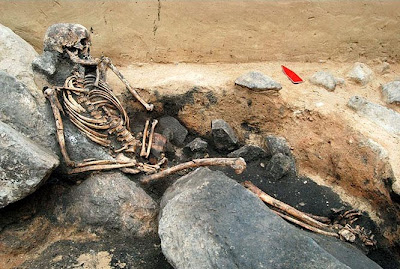
I can't think of anything I would like to add, but I am more moved by the recent discovery of an amazing Bronze-age burial site during railroad construction last year in Germany, described here and here. The woman appears to have gently laid herself down to sleep on these stones, which I suppose were covered with sand, some 3000 years ago. I wonder how many people living in America today might possibly be descended from her.